
Sun protection and monitoring moles: allies for your skin?
With the arrival of summer, many people spend more time outdoors. While the sun is one of the pleasures of the warm season, exposure to ultraviolet (UV) rays can contribute to skin changes over time. Repeated or significant UV exposure is also recognized as a risk factor associated with certain skin cancers, including melanoma.
That is why it is important to protect your skin properly and remain attentive to changes in your moles as well as the appearance of new skin lesions.
Why monitor your moles?
Our skin naturally changes with age. Sun exposure, genetic factors and other elements can also influence the appearance of new moles or alter existing ones.
Most moles are benign. However, some changes can sometimes be associated with more concerning skin lesions, including melanoma, a form of skin cancer.
Regular monitoring helps you become more familiar with your skin and makes it easier to notice the appearance of new lesions or changes in existing marks.
What skin changes should catch your attention?
Healthcare professionals often use the “ABCDE” rule to assess certain skin changes:
A — Asymmetry
One half of the mole looks different from the other.
B — Border
The edges appear irregular or poorly defined.
C — Color
Several shades are present in the same lesion.
D — Diameter
The mole is increasing in size or has a large diameter.
E — Evolution
The lesion changes in appearance over time or develops new symptoms such as itching or bleeding.
If you notice any of these changes, it is recommended that you consult a healthcare professional.
How can you protect your skin from the sun?
Repeated exposure to UV rays can contribute to skin aging and certain skin changes. That is why sun protection measures remain important throughout the summer.
To help protect your skin:
- apply a broad-spectrum sunscreen;
- wear a hat and protective clothing;
- choose shaded areas whenever possible;
- avoid tanning salons;
- regularly watch for new lesions or skin changes.
Mole mapping: a new way to monitor your skin
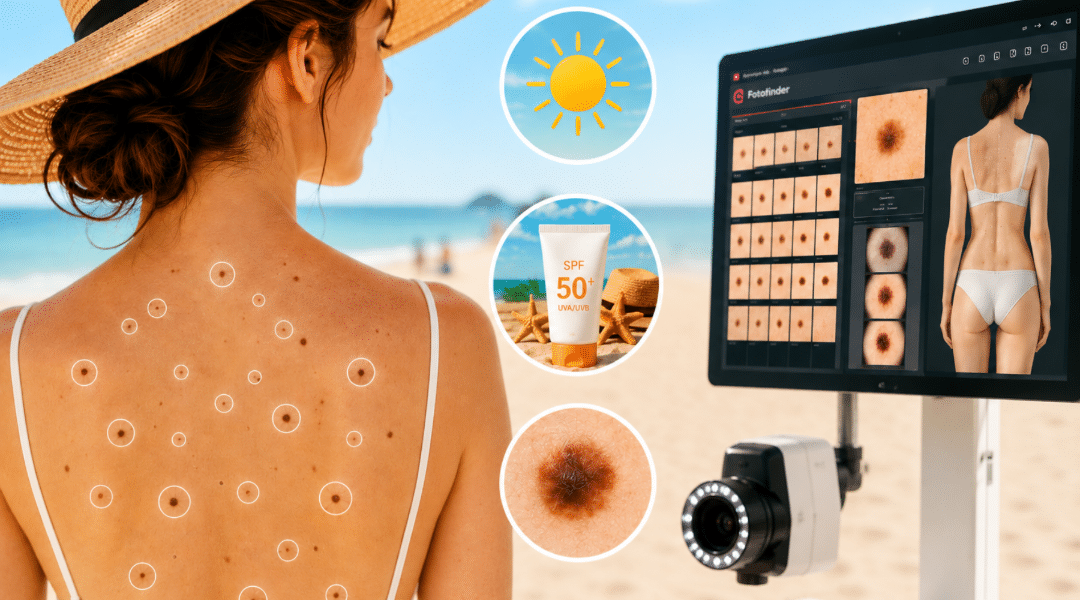
In collaboration with Derme Image, Radimed offers a mole mapping service, also known by the English term Mole Mapping.
This technology makes it possible to photograph and document moles as well as certain pigmented lesions in order to monitor them over time. The images obtained can be compared from one visit to the next to make it easier to observe possible changes and support medical assessment when considered necessary.
Mole mapping is a monitoring tool that can contribute to earlier detection of certain skin changes, particularly those that may be associated with melanoma. It also provides an overall view of the skin and documents how it changes over time.
Who can benefit from mole mapping?
This type of monitoring may be particularly relevant for people who:
- have many moles;
- have fair skin or skin that is sensitive to the sun;
- have a personal or family history of melanoma;
- regularly notice the appearance of new moles;
- wish to carry out rigorous photographic monitoring of their skin.
Because every situation is unique, a healthcare professional can determine whether this type of monitoring is appropriate.
Getting to know your skin better
Regular skin monitoring remains a good habit to adopt, especially during the summer months. Paying attention to observed changes and consulting when a lesion seems to be evolving can contribute to quicker care when necessary.
The mole mapping service offered by Radimed in collaboration with Derme Image is part of an approach focused on prevention and skin health follow-up.
The sun leaves its mark. Observing and monitoring those marks remains a simple way to take care of your skin, today and tomorrow.
To learn more about the mole mapping service offered by Radimed in collaboration with Derme Image, do not hesitate to contact our team.
Sources
- Canadian Cancer Society. Melanoma and skin cancer. https://cancer.ca
- Canadian Dermatology Association. https://dermatologue.ca
- Government of Canada. Ultraviolet radiation and sun protection. https://www.canada.ca
- Melanoma Canada. https://melanomacanada.ca